

Lessons In Physics
Introduction
In this post, we are covering moments as they relate to physics and statics. Moments are a topic that confuses many new physicist and engineers alike. I hope to clarify some points and explain what a moments are, and how we find them.
Please check out my other posts in the Lessons In Physics series:
Newton’s Laws of Motion
Understanding Forces in Physics
Kinetic and Potential Energy
Gravity
Constant Acceleration
What Is A Moment?
A moment is a value associated with an object’s tendency to rotate or bend. It is a force times a distance with the standard units being Newton-Meters or Pound-Feet.
We are going to look at two moments. The moment of force, also known as torque. That is when you have something like a wrench rotating around a fixed point, such as a bolt. The second moment is a moment of mass, where we can find where the center of mass, also often referred to the center of gravity, of an object or a collection of objects. There are other moments like inertia and electrical charges, but we’ll save those for another time.
Go ahead and ask the question: Where are we going to use this?
Moments are essential calculations in physics and engineering, as well as in places you might not expect like flying airplanes and fixing cars. When analyzing static systems (think bridges), you can use moments to find unknown reaction forces at the supports. When pilots do a weight and balance of their aircraft before they fly, they are really calculating moments caused by the loading configuration of the aircraft. When a mechanic applies torque to a bolt, they are applying a moment.
Moment of Force (Torque)
Torque is the most common moment that we face on a daily basis. It is a measure of force at a distance perpendicular to the axis of rotation.
Turning About a Point
A torque spec for a bolt, is given in foot-pounds or pound-feet. Let’s say that the torque needed on a bolt is 10 lb-ft. That means that if my wrench were one foot long, I would need to apply 10 pounds of force at the very end. Or, if I happened to have a 10 foot long wrench, then I would only need to apply one pound of force.
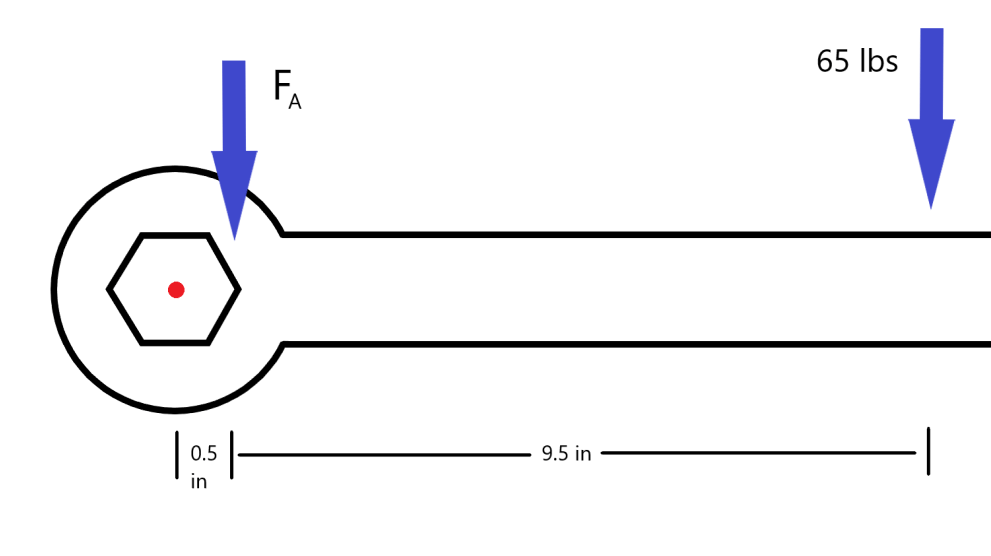
In this example, we have a wrench on a bolt head. The red dot indicates the axis of rotation, If a force of 65 lbs is applied to the wrench 10 inches from the axis of rotation, how much force is applied at the edge of the bolt head? For this we need to use moments.

Notice how are units are in inch-pounds. This is another common unit used in low-torque applications, or for center of gravity calculations on airplanes. Since we are finding a force, our distance units will cancel so they don’t matter as long as we are consistent. Now that we have the total torque (moment) on the system, we can find the value of FA. To find FA, we just divide the total torque by the distance of FA from the axis of rotation.

If you have ever wondered how you can break off a steel bolt head while turning it with a wrench, this is how. A force of 65 lbs 10 inches away, exerts a force of 1300 lbs half an inch away from the axis of rotation!
Balance On A Fulcrum

We can also use moments to balance an object on a fulcrum. Let’s say that we have a plank that is 4 feet long and is balanced on a fulcrum one foot from one end, three feet from the other end. If we set a 15 lb box at the end of the 3 foot segment, how much force do we need to apply at the end of the one foot segment to balance the load?
To find the answer, we need to find the moment the box puts on the system. That is how much the box makes the plank rotate and in which direction. We know that the box weighs 15 lbs, and the distance from the fulcrum point (the arm) is 3 feet.

The box imparts a moment on the system of 45 lb-ft in the counterclockwise direction. Using general sign convention for moments, the counterclockwise direction is the positive direction. In a static system, where everything is balanced (nothing is moving), the sum of the moments should equal zero.
To balance this system, we need to have clockwise moment of 45 lb-ft. Since we know the length of the arm, we can divide the moment on the left side by the arm on the right side and we’ll get the force needed to balance the system.

Difference Between “About” and “At”
It is important to understand that when you are calculating a moment, you are calculating it about (around) a certain point. Which means that in the example above, we were calculating the moment about the fulcrum. We needed to know how the box made the plank move around (about) the fulcrum, and how much force we needed on the other end to keep the plank horizontal at the fulcrum. The weight of the box made the plank want to rotate counterclockwise around the fulcrum and the applied force made the plank rotate clockwise.
If you were to calculate the moment at the fulcrum, the answer would be zero. That is because a moment is both a force and a distance. You can have a force applied at the fulcrum, but the distance is zero, so the moment is zero. This concept is very handy when analyzing a static system where need to see how much force is on the supports.
Moments to Find Reaction Forces

For this example, we have two supports holding a 20 foot plank. The plank has a 200 lb object placed 5 feet from point A. What are the reaction forces at support A and support B? To solve this problem, we would usually use a combination of the sum of moments and the sum of forces to find the answers. Since we are talking moments, we are going to use only moment equations to calculate the answers.
Pick A Starting Point
Let’s say the first reaction force we want to find is FB. In order to find FB we can find the moment about support A. Since this is a static system, the sum of the moments should be zero.

Notice how the load force in the moment equation is negative. That is because the force would make the plank move in the clockwise direction about support A, which is the negative direction. Conversely, the reaction force at support B is positive because it wants to make the plank move in the counterclockwise direction.
Moment About Support B
To find the other reaction force, we only need to switch our reference point to support B.

To check your math, you can use the sum of forces equation, which states that in a static system the sum of the forces in any direction (in this case the y-direction) is equal to zero.

Center Of Mass

In this example we are preparing to lift an object, comprised of 4 components, with a crane. The components are bolted together so they are rigid in their orientation. In order to have a stable lift, we need find the center of mass or center of gravity of the object. We want the hook to be at the center of gravity so that the load is balanced.
Datum
When doing a calculation like this, you need to have a reference point. The datum is an imaginary line from which all distances are measured. Ideally, you want your datum line to be somewhere easy to reference, like a particular face of your object. But a datum line can be anywhere. It doesn’t even have to be on the object. It can also be somewhere in the object. Some airplanes have their datum line at the tip of the propeller spinner, while some may have it at the firewall between the engine and the cockpit. For this example, I chose an arbitrary datum in the confines of the object so you may see how we deal with these situations.
Component Accounting
To find the center of mass of the object, we need calculate moments for each component when referenced to the datum. Each component has its own center of gravity and that point is needed to do these calculations.
| Component | Weight (lb) | Location (ft) | Moment (lb-ft) |
| A | 1200 | 2.0 | 2400 |
| B | 1600 | -1.5 | -2400 |
| C | 950 | 8.0 | 7600 |
| D | 450 | 2.5 | 1125 |
| Total | 4200 | 8725 |
Calculate the moment of each component by multiplying their weight by their location (that component’s center of mass in relation to the datum). Notice how component B has a location of -1.5 ft. That is because the component’s center of mass lies in front (left) of the datum. Points behind (right) of the datum are considered positive while points in front (left) are negative by convention.
After you calculate the moments for each component, add up the weight column and the moment column. Do not add up the location column. With the total moment and the total weight, you can find where the center of gravity (CG) is by dividing the total moment by the total weight. In this case, our CG is located at 2.08 ft behind (right) of the datum line.
A Different Way
What happens when you don’t know the weight of an object, or the weight of the individual components? How can you determine the center of gravity? There is another method using scales and a datum line to find the center of gravity. This method is used in aviation to keep track of the weight of an aircraft throughout it’s life. As an aircraft ages, it tends to accumulate more stuff in it, which increases weight and changes the center of gravity.

To find the center of gravity of an object, in this case a Cessna 172, you’ll need a few scales (3). With a scale under each wheel – one nose wheel and two main wheels – read the weights that each scale is displaying. In this case, the nose gear has 330 lbs of weight on it, while the main gear have 660 lbs each. Now we do the same component accounting to get the CG. The published datum for the 172 is the firewall.
| Component | Weight (lbs) | Location (in) | Moment (in-lbs) |
| Nose Gear | 330 | -34.0 | -11,220 |
| Main Gear | 1320 | 59.0 | 77,880 |
| Total | 1650 | 66,660 |
Since both of the main landing gear are the same distance from the datum, we can combine them by adding their weights together. Adding all the weights and moments, we have the total aircraft weight and the total moment. To find the location of the CG in inches from the datum, we just divide total moment by the total weight. That gives us a CG of 40.4 inches.
Thank You
Thank you for reading my post. If you find that you gained some knowledge and would like to read more, please consider giving us a like and subscribing. It’s free and it helps us get sponsors for future content. Also if you feel we are worthy of a small donation, you can leave a tip at the button below. Every little bit helps as the projects can be quite costly.
Leave a Reply