
Lessons in Physics
Introduction:
Newton’s Laws of Motion are essential to understanding most physics problems. In this lesson, we will cover what these laws of motion are, and some basic examples. This is a basic overview of the Laws of Motion.
Newton’s Laws of Motion:
- Newton’s 1st Law of Motion: If no net force acts on a body it remains at rest, or in motion at a constant velocity.
- Newton’s 2nd Law of Motion: The net force on a body is equal to the product of its mass and its acceleration. F = ma.
- Newton’s 3rd Law of Motion: When there is an interaction between two bodies, the force is equal in magnitude and opposite in direction.
The 1st Law of Motion:
A body in motion remains in motion and a body at rest remains at rest unless a net force is applied. What does that mean?
Everything around you, including you, has force acting on it at all times. However, you don’t always feel like you are being pushed or pulled. That is because when you are sitting at your desk or sitting in an airplane at cruising altitude, the forces acting on your body cancel each other. So the net force is zero.
Body At Rest

In Figure PH-1-1, shows a box at rest on a table. Just because the box is at rest, it does not mean that there are no forces acting on it. In this case, the force of gravity is opposed by the normal force (the force the table provides to hold the box). If the box is stationary and not moving, then the two forces are equal to each other. If no additional force is added, the box remains at rest.
Body in Motion

When the table is removed, the box falls because of the loss of the normal force. The box continues to fall until another force acts on it. In this case, when the box hits the ground, a new normal force opposes its motion.
The 2nd Law of Motion:
The net force on a body is equal to its mass times its acceleration.
If you have two spheres of identical size, one sphere has a mass of 10 pounds and the other sphere is 10,000 pounds, and you roll them off the top of a building, what will the force be like? For simplicity, we will assume no air resistance, although with identical spheres, air resistance would effect them equally.

The first thing you might assume is that the 10,000 lb sphere will hit the ground first, but that is not true. The two objects will hit the ground at the same time. When dropped from the same height, both objects have the same amount of time to accelerate due to gravity. Which means they hit the ground at the same speed too.
The difference is the amount of force that the earth needs to apply to the object to get it moving at the specific acceleration (gravity in this case). It is also the force needed to stop the object at the same rate*. In this lesson we will not be covering potential and kinetic energy, but that will bring a different aspect to the problem.

For the lighter sphere, the force would be equal to its mass (10 lb) x gravity (32.2
ft/s2). That gives the smaller sphere a force of 322 pound-force (lbf). The larger sphere would have a force of 322,000 lbf. Remember, a force gets an object moving, or slows down an object. More importantly, the force acting on the object is the same no matter the height. As long as the mass and the acceleration are the same, the force will be the same.
*If a force applied to an object to stop it is equal to the force used to get it moving, the negative acceleration (deceleration) will be the same. If the force is lower, it will slow down at a slower rate.
The 3rd Law of Motion:
The most common way of saying this law is, for every action there is an equal and opposite reaction.
What this law of motion tells us is that for every interaction between two objects, the forces are equal in magnitude and opposite in direction. For example, the earth pulls you towards the center. That is gravity. But did you know that you also have gravity and you are pulling up on the earth with the same force as it is pulling down on you? The difference is that the earth has a lot more mass than you, so with the same force applied, the earth’s acceleration is so small that it is not measurable.
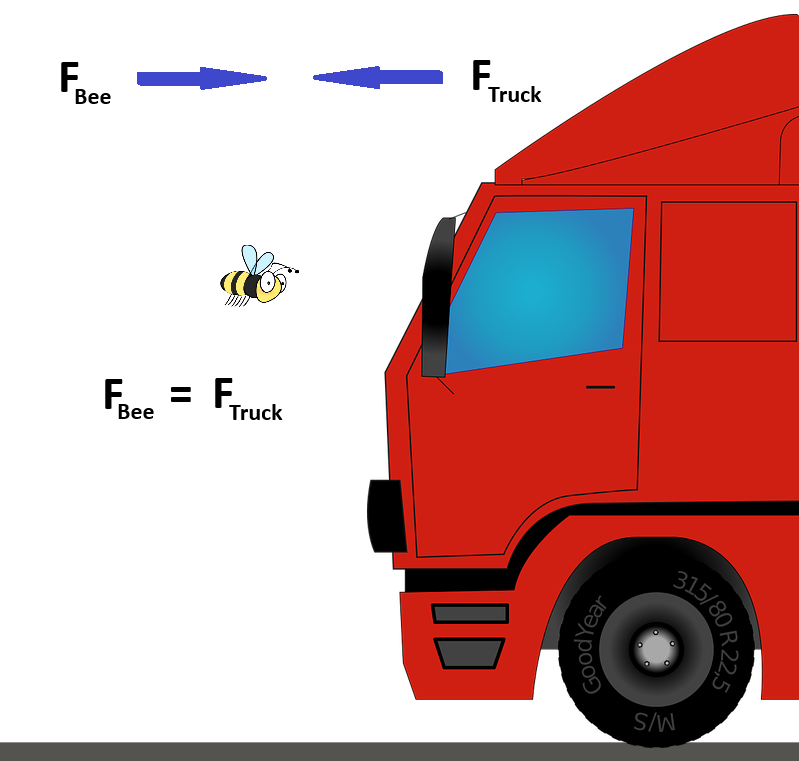
A truck driving down the highway at 70 miles per hour hits a bug on the windshield. When this happens, the bug hits the truck with the same force that the truck hits the bug. The difference again is the mass. If the force is the same and the mass is smaller (bug size), the resulting acceleration for the bug is life-altering. For the truck, because it has so much more mass than the bug, the acceleration would be unnoticeable. The bigger problem for the truck is the mess on the windshield.

Educational Series
In the educational series, I look at the basics of different subjects that engineers and pretend engineers face. This is intended as an overview of certain concepts, so people can familiarize themselves with the topic. As we progress in this series, we will get more in-depth and start tackling some real problems and actually go through how to solve them.
Thank You
Thank you for taking the time to read this post. I hope that you gained some understanding about Newton’s Laws of Motion and you can apply it as needed. If you like this content and want to see more, please consider subscribing. It really helps to get this content out there. If you feel we are worth, please consider leaving a small tip as some of the projects featured on this blog can require significant resources.
Leave a Reply