
Lessons in Physics – Part 2
Introduction
Understanding forces in physics is one of the core principles of the subject. In this post we will cover the basics of forces and cover some of the different kinds of forces that are encountered on a regular basis.
Please take a moment to review my post Newton’s Laws of Motion, as they will be important to this lesson.
What is a force?
A force is a measure of what it takes to accelerate a mass. Everything has mass so in order to get it to accelerate (move or stop), a force must be applied. If an object is not moving or is moving in a straight line at a constant velocity, then the forces on the object are in equilibrium. Below are a list of the different forces.
Contact Forces
- Applied Force = A force that is applied to an object by a person or another object.
- Normal Force = A force applied to an object that is perpendicular to the surface the object rests against.
- Friction Force = A force between two objects at the contact plane that opposes motion. The two types of friction are static and kinetic.
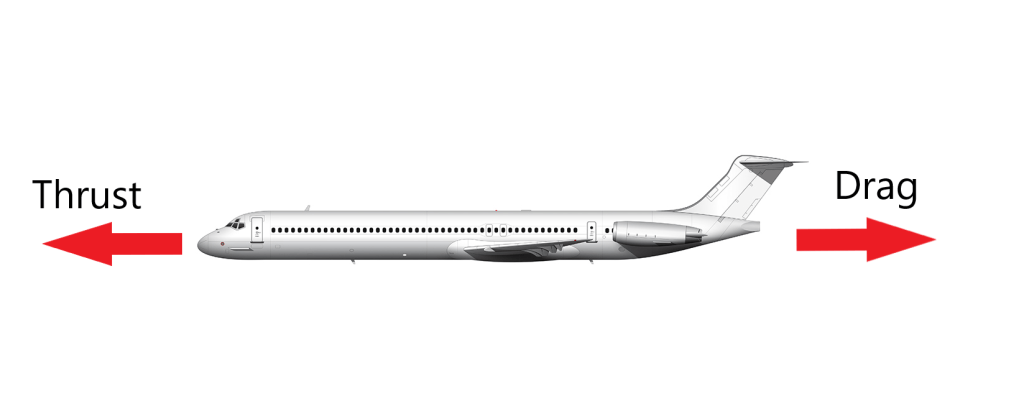
- Drag Force = Drag is a type of frictional force but it is specific to motion through air.
- Tension Force = A force in an object when it experiences forces pulling at each end.
- Spring Force = A force from the compression or stretching of a spring.
Non-Contact Forces
- Gravitational Force = A force by which a planet or other body pulls and object towards its center. Often referred to as weight.
- Electrical Force = A force due to electrical charges that can either cause two objects to repel or attract.
- Magnetic Force = A force resulting from the movement of a charged particle through a magnetic field.
Gravitational Force
This will be the only non-contact force we will cover in this post, because it is far too important to leave it out. Gravitational force is what we call weight. Gravity is an attraction between two objects that have mass. The attraction is know as a force, which acts equally between the two objects, but opposite in direction. Any time a force is applied to a mass, you have an acceleration. A gravitational acceleration.
Please note that this is a simplified version of Newton’s gravitational equation. For objects on or near the earth’s surface, the mass of that object is negligible compared to the earth’s mass.
Difference Between Weight and Mass
There is a difference between weight and mass. Mass is all of the molecules that make up a person or object. Weight is the force that mass exerts on any object between it and the gravitational center (center of the earth). Mass doesn’t change, but weight can change if you were under a different gravitational acceleration. The moon, for example, has 1/6 of earth’s gravitational acceleration. That means a person on the moon would weigh 1/6 of what they weigh on earth, despite having the same mass.
Many people get confused when working in English units. Pound is often referred to as mass and weight. The true mass unit in English units is the slug, which is equal to the mass that can be accelerated at 1 ft/s2 when 1 pound of force is applied.
Pounds can also be referred to as a mass. In engineering, especially in the United States, a pound can be a mass (lb or lbm), or it can be a force (lbf). Pound-force is the result of the pound mass when multiplied by the gravitational acceleration. If you see (lb or lbm), then it is generally referring to a pound-mass (no gravitational acceleration). If you see (lbf), then that number includes the gravitational acceleration of 32.2 ft/s2.
For the metric system, it is a little easier. The mass unit is kilograms (kg), gravity is 9.81 m/s2, and the unit of force is Newtons (N).
Applied Force
An applied force is just any force that a person or object exerts on another object. For example, a person pushing or pulling a box is an applied force. An aircraft engine producing thrust is an applied force. Applied forces are contact forces, which means that the two objects need to make contact for the force to be applied.
Normal Force
Normal force is the force that is applied by an object that is not undergoing an acceleration of its own. The reason a person doesn’t fall to the center of the earth is because the earth’s surface exerts a normal force on that person. The normal force is equal to the gravitational force but is opposite in direction (pushing up). The same force is applied if a person leans against a wall. Their weight (force) is opposed equally by the wall. If the object is on an inline then the normal force is multiplied by the cosine of the incline angle.

Friction Forces
Friction force is something that directly opposes motion. If a heavy box sits on the ground and a person tries to slide it across the ground, it will create friction between the bottom of the box and the surface of the ground. That friction vector will point in the opposite direction of the force trying to move the box.
There are two types of friction, static friction (Fs) and kinetic friction (Fk), sometimes known as dynamic friction. Static friction of an object is always higher than the kinetic friction of that object. That is why if you try to slide a heavy object across the floor, it feels harder to get it moving than it does to keep it moving. Kinetic friction depends on the two surfaces in contact, but is independent of the velocity. No matter how fast you push, the kinetic friction will be the same. The force of friction is the coefficient of friction times the normal force on the object. The coefficient of friction is different depending on if it is static or kinetic, and the composition of the two surfaces.

Drag Force
Drag force (D) is like a frictional force, but it deals specifically with moving through fluids (air is a fluid). Like friction, drag opposes the motion of the object. Unlike friction, drag is dependent on area and velocity, as well as the properties of the fluid.
There are two different types of drag, parasite drag and induced drag. Induced drag, often called lift-induced drag is drag that results from an aircraft wing producing lift. Parasite drag includes form drag, skin friction, interference drag, ram (cooling) drag, and wave drag.
Drag force is a little too complicated to calculate for this lesson. Just know that when an aircraft flies through the air, or a submarine moves through water, it experiences drag. That drag opposes its direction of motion, and when it equals thrust, the vehicle is at a constant speed.
The formula for drag is one half the coefficient of drag times the density of the fluid times the velocity squared, times the frontal area. A more accurate drag calculation involves calculating the different types of drag for each component and adding them, but this is the generic equation.
Tension Force
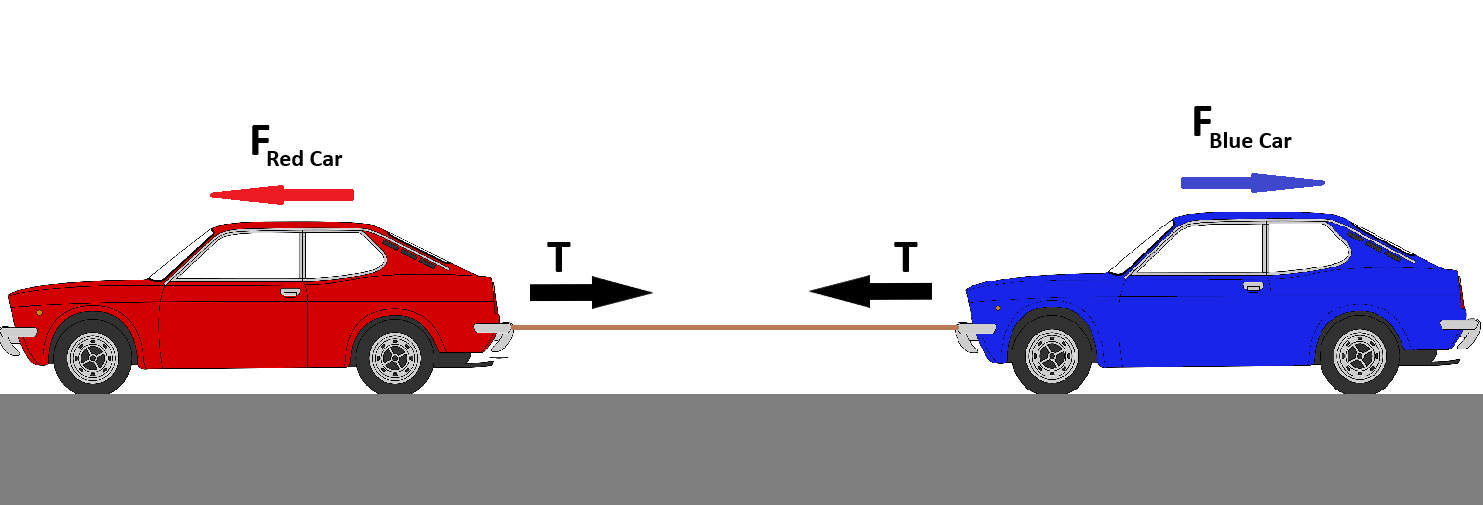
Tension force is something you would find in a rope, cable, or beam. It occurs when a force is applied at both ends of the object in opposite directions. For example, a car towing another car. The first car is using its power to pull on its end of the rope. The second car (one being towed) has a mass. In order to move the mass, it needs to accelerate, which creates a force via Newton’s 2nd Law of Motion. This creates a case where the tow rope is in tension because it has force on both ends, opposite to each other. Tension is a pulling force, so the rope pulls back on the red car while pulling forward on the blue car and is equal to mass times acceleration of the blue car in this case.

Another example is of a weight hanging by a string from a roof, T = W (mg). If that weight were to be pulled up at some rate, T = W + ma or T = mg + ma.
Spring Force
Spring force is dependent on displacement. According to Hooke’s Law, the force needed to extend or compress a spring is proportional to the distance from its equilibrium (resting length) multiplied by a spring constant (k).

Notice that the spring constant is negative. This is because if the spring is pulled outward, the force will be trying to pull the spring back in. If the spring is compressed, the force of the spring will be trying to push outward.
Thank You
Thank you for taking the time to read this post. I hope that you gained some understanding about Newton’s Laws of Motion and you can apply it as needed. If you like this content and want to see more, please consider subscribing. It really helps to get this content out there. If you feel we are worth, please consider leaving a small tip as some of the projects featured on this blog can require significant resources.
Leave a Reply