
Lessons in Physics
Introduction
In this post, we are talking about gravity. You may think you know everything about gravity, but you might be missing out on some interesting information. Keep in mind that the information on gravity is enough to make an entire series of it, but we’ll engage the topic with a few basics for now.
Please take a moment to read my other lessons in physics to make sure you are up to date. It will help you understand these concepts if you are new to physics.
What is gravity?
Gravity is a force between two objects that have mass. When that force is applied to a mass, the mass will accelerate, which is where we get the acceleration of gravity.
Everything that has mass, even down to the sub atomic particle level, has gravity. It will naturally attract other objects that are nearby. So why aren’t we all stuck together? Why can I pick up the salt shaker at the dinner table and set it down easily? That is because the gravitational force is actually very weak. Although it may not feel that way when you are falling off a ladder!
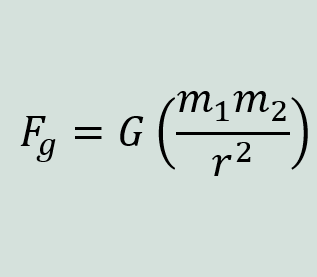
Newton’s Universal Law of Gravitation

Where:
Fg = Force of gravity (N)
G = Gravitational constant (m3/s2 * kg)
m1 = mass of the first object (kg)
m2 = mass of the second object (kg)
r = radius between the center of the two objects
The force of gravity is a multiplication of the two masses divided by the distance between the two objects squared, multiplied by the Gravitational constant. What this also means is that gravitational force is inversely proportional to the distance between the two objects. This means that the closer the two objects get to each other, the stronger the gravitational pull.
For example, let’s take a salt shaker and a pepper shaker on the dinner table. Both objects have mass and therefore have a gravitational pull towards each other. Sitting a few feet apart, the distance may be too great for the gravity to have an effect. But then we move the two shakers together, separated only by a piece of paper. What happens when the paper is removed?
The answer is nothing. Why is this true? Despite the items being so close together, gravitational force is such a weak force that it cannot overcome the friction of the table. If you want to know just how weak the force is, use your finger push the two shakers together. Did it take much force?
Gravitational Constant

I know this looks like a big, and intimidating number, but if you’ll notice that the exponent is -11. That means that there are 10 zeros before the number starts. This is a tiny number. So why does the gravity on Earth feel so strong? Because Earth is massive! Earth has a mass of 5.98 x 1024 kg. That’s 598 with 22 zeros after it! If you want that in pounds, multiply that number by 2.2.
Calculating gravitational acceleration
Problem 1. A man with a mass of 90 kg is standing on the surface of the earth. Using Newton’s Universal Law of Gravitation, calculate the force of gravity acting on the man, and the gravitational acceleration.
mman = 90 kg
mearth = 5.98 x 1024 kg
radius = 6.37 x10⁶ m
Let’s plug in the numbers into Newton’s Universal Law of Gravitation and get an answer to 3 significant figures.


We can simplify the units:

We know that a kg is a mass unit. We also know that m/s2 is an acceleration. Therefore, when we have a mass times an acceleration, we have a force. In SI units, the force is a Newton (N).
Now we want to find what the acceleration of the man is if he were in free fall. To do this, we only need to take the force of gravity and divide by his mass, which leaves us with an acceleration.


Why is the acceleration of gravity the same on every object on Earth regardless of its mass, if its mass is one of the factors for calculating the force of gravity? That is because of scale. The earth is so large and has so much mass, that the mass of any object on Earth is so insignificant that it can often be discarded.
Gravity on the International Space Station
We have all seen the images of our brave astronauts in space floating around, having a good time. The terms “Zero G”, “weightless”, and “microgravity” are often used to describe space, but is this true? Let’s find the force of gravity and the gravitational acceleration on the International Space Station (ISS). The ISS orbits the earth at approximately 400 km in altitude and weighs approximately 450,000 kg.
mearth = 5.98 x 1024 kg
mISS = 4.50 x 10⁵ kg
radius = 6.37 x 10⁶ + 4.00 x 10⁵ m = 6.77 x 10⁶ m
Let’s go through the same process we did above to find what the force of gravity and the gravitational acceleration are on the ISS. If there is no gravity, we should get 0 N.


Well that’s not zero! So this means that there is gravity on the space station. Let’s calculate the acceleration of gravity on the ISS.


If there is gravity on the ISS, then why do we see the astronauts floating? This is a function of orbital mechanics. To put a spacecraft into orbit, it needs to travel at a high velocity. For the ISS and other Low Earth Orbit (LEO) spacecraft, the speed is 28,000 kph or 17,500 mph.
When a spacecraft reaches these speeds, it is going fast enough that as gravity pulls it back towards the center of earth, it has already moved to a point where it misses the earth. Because the earth is round (sorry flat Earthers!) the spacecraft is actually in constant free fall. When a mass is in free fall, it is weightless. It only feels its weight (force of gravity) when there is another object to push back against it.
Want to get away?
What if you want your spacecraft to do something other than orbit the earth? Let’s say you want it to go to another place, like the moon or Mars. We already proved that there is gravity in space, and if you think about it, that should be evident because the moon is held in Earth’s orbit by gravity. So how do we get away from Earth’s gravity? We have to go fast!
Escape Velocity
In order to get away from Earth, so that you don’t return naturally, you need to reach the escape velocity. Escape velocity is the speed at which a spacecraft must travel to break free of the earth’s gravitational force. For now, we won’t get into the derivation of this equation, but a lot of the components should look familiar to you.

To find the escape velocity of Earth, we need to plug in Earth’s mass and radius.


The escape velocity of Earth is 1.12 x 10⁴ m/s, which is approximately 25,000 mph!
Thank You
Thank you for reading my post. If you find that you gained some knowledge and would like to read more, please consider giving us a like and subscribing. It’s free and it helps us get sponsors for future content. Also if you feel we are worthy of a small donation, you can leave a tip at the button below. Every little bit helps as the projects can be quite costly.
Leave a Reply