
Lessons in Physics
Introduction
In this post we will learn how to solve problems dealing with constant acceleration. If you have not read the previous posts in the Lessons in Physics series, please do so.
Gravity
Kinetic and Potential Energy
Understanding Forces in Physics
Newton’s Laws of Motion
What Is Constant Acceleration?
A constant acceleration condition is when an object is enacted upon by a steady force. This is common in free-fall problems where the object is being acted upon only by gravity. Another place where you see constant acceleration is when a driver slams on the brakes of their vehicle (assuming the wheels don’t lock up). Basically, it is a problem where Newton’s Second Law of Motion, F = ma, has the values of all the component remain the same through the studied event.
An example of non-constant acceleration would be a rocket launch. While the force of the rocket engines remains the same (for the most part), the mass of the vehicle drops as it burns fuel and therefore the acceleration increases. Another example where there is not constant acceleration would be a steady-state situation where the net force on an object is zero. Zero net force means no acceleration.
Equations
Sorry, there is no getting around doing math in this one. And to do the math, we need to have the equations. Since this post is about solving the problems, not deriving the equations, I will provide them below. These are the constant acceleration equations, also known at the kinematic equations.

Where:
v = final velocity (m/s or ft/s)
v0 = initial velocity (m/s or ft/s)
x = final position (m or ft)
x0 = initial position (m or ft)
x-x0 = total change in position (distance, m or ft)
a = acceleration (m/s2 or ft/s2)
t = time (s)
One thing to pay attention to is what is missing from all of these equations. Mass! In any sort of free-fall problem, the mass of the object is irrelevant.
Constant Acceleration Problem 1

In this problem, we have an object that is being dropped from a height of (h). The object has an initial velocity of 0 m/s, acceleration due to gravity is 9.8 m/s2, and the time it takes for the object to hit the ground is 3.194 s. What is the height from which the object is dropped and what is the final velocity as it hits the ground?
How To Solve
For this problem, we don’t have a single equation that can answer both questions. So we need to have two equations. In many cases, you’ll have to solve for one variable to solve for the other. But in this case, we can solve each question independently.
Solve For Height
Let’s solve for height first. We will use the equation from the third row of our table as it does not require the final velocity to solve.

Height is the same as distance traveled in this case, so we can replace the x-x0 with h. The v0t part of the equation is crossed out because 0 velocity times time is zero. So that leaves us with the second half of the equation.

Notice how the answer is 49.99 m, when the actual answer is 50 m. That is because of a rounding error in the time given. When solving problems like this, it helps to carry out to several decimal places (or use the exact number) during your intermediate calculations. Only round to the significant figures at the very end.
Solve For Final Velocity
Now we will solve for final velocity. For this we will use the first equation from our table.

Constant Acceleration Problem 2

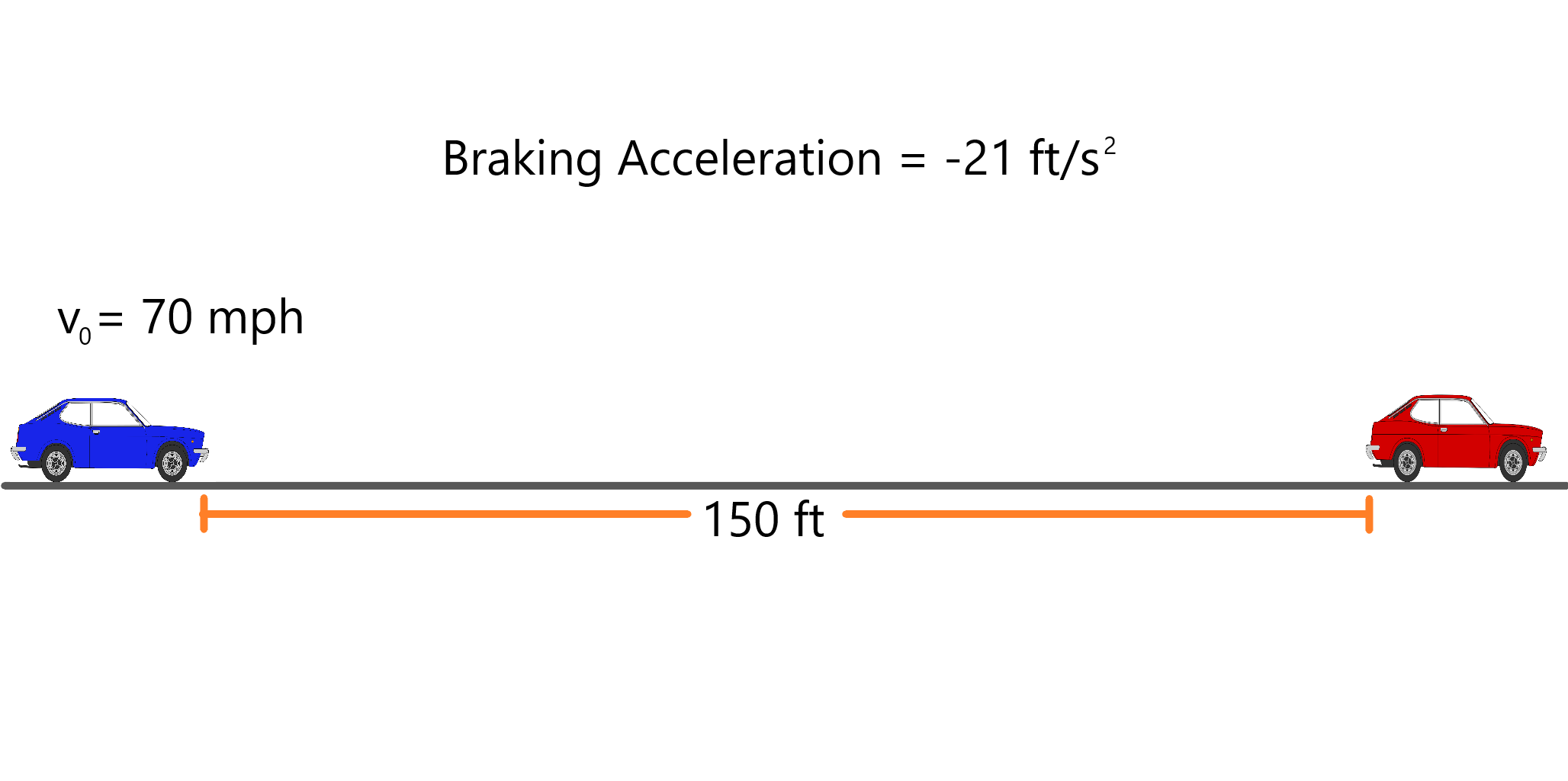
In problem 2, a car is traveling at 70 mph when the driver notices a car stopped on the road 150 feet in front of him. His brakes create a constant acceleration of -21 ft/s2. Can the blue car stop before hitting the red car?
How To Solve
There are two ways of solving this problem. The first way is to solve for the distance it would take to bring the blue car’s velocity down to zero. The second way is to solve for the final velocity at the given distance. Either method will show whether or not the vehicle stops in time. If the distance is greater than 150 feet, or the velocity is not zero, the the vehicle did not stop in time.
Distance Method
We are going to solve for distance. What we know is the initial velocity of the blue car, which is 70 mph. We know the distance we need to stop in, but we don’t know the distance it will take to stop. The braking acceleration is also known to be -21 ft/s2. Notice that this number is negative because the acceleration happens in the direction opposite of travel (vector quantity).
We need to pay attention to our units. The velocity is in miles per hour. In order for our equation to work, we need our units to be feet per second. Let’s do that first. Please note that this is a shortened version of converting units, which is why the units don’t seem to cancel. This method is more like multiplying by a known conversion factor.

We can actually reduce the 5280/3600 down to its simplest form of 22/15. That means that 1 mile per hour is equal to moving 22 feet every 15 seconds. And if you want to change feet per seconds back to miles per hour, just multiply by 15/22.

Solve For Time
Looking at the table, we don’t have an equation that solves for distance without the time variable. So in order to solve for distance first, we need to know time.

Rearrange the variables to solve for time.

Solve For Distance
Now that we have all the components needed, we can solve for distance using the third equation in the table.

It is clear that the vehicle will not stop in time. Let’s see how fast the blue car is still traveling when it hits the red car.
Solve For Impact Velocity
We know the blue car will impact the red car in 150 feet. Because our time was for how long it would take the blue car to come to a complete stop, we can’t use it in this equation. To find the final velocity, we need to use the second equation from the table.

Most people don’t think in feet per seconds, so let’s convert this velocity back to miles per hour.

Analysis
In problem one, we found that the final velocity was a simple multiplication of the acceleration and time. That is because velocity has a linear relationship with time in constant acceleration events. The object will increase its velocity by the magnitude of the acceleration every second.
In problem two, you may have noticed something different. We calculated the total stopping distance to be ~251 feet. More than half of the total distance needed to stop the car (59.76%) was traveled before impact. However, the velocity had only been reduced by 36.57%. This is because the relationship between velocity and distance in a constant acceleration event, is not linear, it is parabolic.
If you calculate the time from slamming on the brakes to impact, you’ll find that it is just 1.816s. Factoring in some rounding errors, that is approximately 37% of the time needed to stop, which is approximately how much velocity had been reduced. This confirms the linear relationship between time and velocity
Thank You
Thank you for reading my post. If you find that you gained some knowledge and would like to read more, please consider giving us a like and subscribing. It’s free and it helps us get sponsors for future content. Also if you feel we are worthy of a small donation, you can leave a tip at the button below. Every little bit helps as the projects can be quite costly.
Leave a Reply