
Aerospace Education
Introduction
In this post, we are going to cover thrust, which is one of the four forces of flight. We’ll go over the physics behind thrust and get into at least one, very contentious misconception. If you are unfamiliar with forces in general, please take a moment to read some of the lessons in physics posted on this site.
Newton’s Laws of Motion
Understanding Forces in Physics
Another important lesson is the one on lift.
How Do Airplanes Create Lift?
Thrust
Thrust is a force. That means in order to have thrust, you must have a mass and an acceleration. For the average aircraft, the mass moved to create thrust is the air. To accelerate that mass of air, most aircraft use a mechanical system of some kind, powered by combustion.
Mechanics of Thrust
Newton’s 3rd Law of Motion also plays a part in thrust, but it may not be what you think. A common misconception is that thrust is created by pushing off the air behind you. This is not accurate.
If you read How Do Airplanes Create Lift, then you know that the wing of an airplane forces the air to turn downward (called downwash). The wing applies a force down, so by Newton’s 3rd Law, there is a force that is equal in magnitude and opposite in direction. That force is lift. Thrust acts the same way, but on a different axis.
Thrust is also created by combusting fuel and directing the expanding hot gases through a nozzle out the back of the engine. The acceleration of the gases is not the actual thrust, it is the reacting force that is equal and opposite. This is why the thrust vector does not point in the direction the air is moving. The thrust vector points in the direction the aircraft is moving.
Increasing Thrust
There are two ways of increasing thrust. One way is to accelerate the air to a higher velocity. That was the concept of the first jet engines (and still the primary method for most fighter jets). Thrust is equal to mass times acceleration. If the same mass of air has a higher acceleration, you get more thrust.
The other way to get more thrust is to move more mass. On a propeller driven aircraft, a larger diameter prop affects a larger mass of air to create more thrust. Modern jet engines are also creating thrust by affecting more mass, making them much more efficient.
Propeller Thrust
Thrust in a conventional airplane is the same concept as lift. In a propeller airplane, the engine turns the propeller, which is a series of small airfoils that turn the air towards the back of the airplane (called propwash). Forcing the air backwards creates an equal and opposite force towards the front. That is called thrust.

There are many different types of propeller engines. Propellers driven by piston engines (piston props) are found on many small aircraft such as a Cessna 172. Turboprops, like in the image above, are turbine powered engines, much like a jet engine, except that the turbine engine is only used to turn the prop. Many helicopters have turboshaft engines. They use a turbine engine to spin a shaft that connects through a gearbox to the main and tail rotors.
Jet Engine Thrust
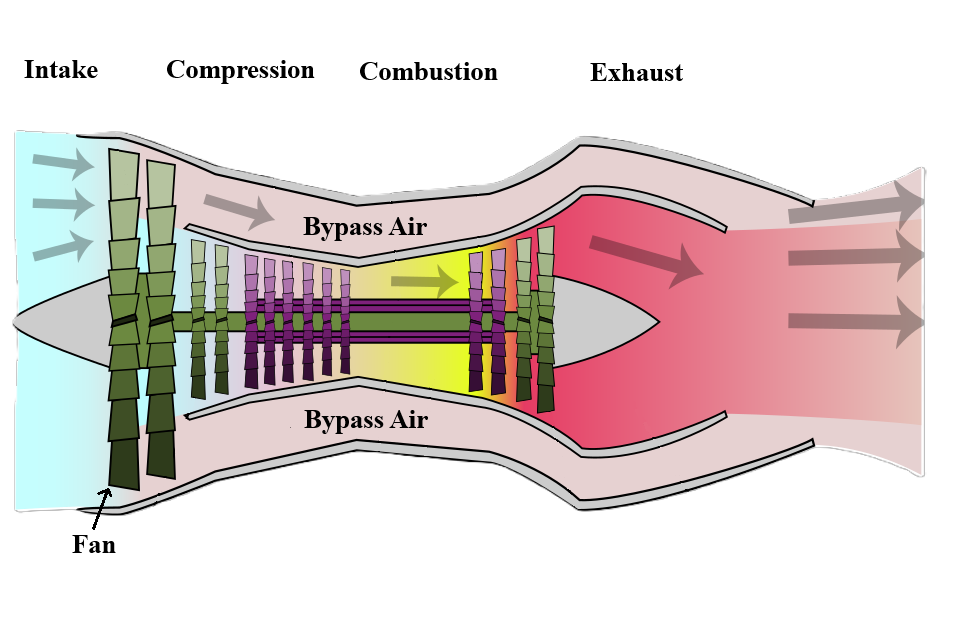
Jet engines, especially hi-bypass turbofans, have two different methods of producing thrust. First, they have a large fan on the front of the engine. That fan is like a propeller with more blades. The turbine engine turns the fan through a set of drive shafts. As the fan spins, it forces the air backwards. Most of this air bypasses the engine core and goes straight back. The bypass air produces most of the thrust on a turbofan engine. The secondary thrust is from the combustion of the fuel in the combustion chamber. As that air heats up and rapidly expands, it exits through the turbines that cause the rest of the engine to turn, and then out the nozzle as thrust.
The reason we moved to hi-bypass turbofans over the pure turbojet engines (no bypass air), is for efficiency and noise. A turbojet engine, like what you find in a modern fighter jet, is very noisy. That is because all of its thrust comes from a smaller mass of air with a high acceleration. It uses combustion to accelerate the air. Because all the acceleration comes from the combustion of the air/fuel mixture, it means that it has to burn a lot of fuel to make that thrust. More air equals more fuel.
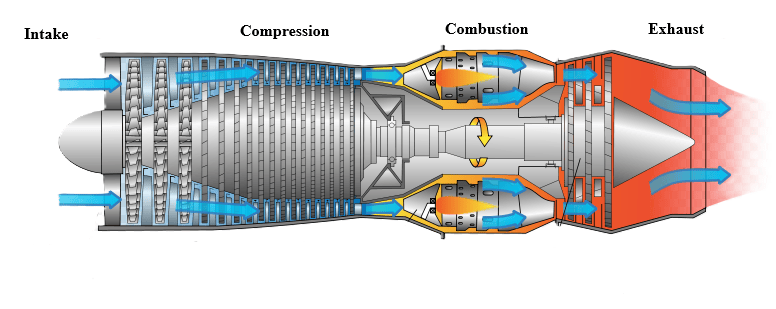
Hi-bypass turbofans don’t send all of the air through the combustion chamber. They have one or more large fans at the front of the engine that are used to accelerate a larger mass of air, most of which bypasses the core of the engine. Less air through the core, equals less fuel.

Which is better, propeller or jet engines?
The answer is that it depends. Propeller driven aircraft are much more efficient at lower speeds and lower altitudes. Propellers can only spin so fast before they encounter some aerodynamic problems. They also lose efficiency as speed increases, and generally have a max speed of around 400 knots (turboprops).
Jet engines are much more efficient at higher altitudes and speeds. These engines are made to go fast and can take advantage of the much thinner air at higher altitudes. However, they are very inefficient at low altitudes and slower speeds. That is why you don’t see jets flying down low unless they are landing or taking off. Also why Cessna hasn’t produced 172’s with a jet engine.
The best mechanism for producing thrust is decided more by the designed purpose and operating conditions of the aircraft. Aircraft that stay low and slow, generally use piston powered propellers. Aircraft that need to go far and fast, use jets. The aircraft that operate in the space between are usually turboprops.
Thank You
Thank you for reading my post. If you find that you gained some knowledge and would like to read more, please consider giving us a like and subscribing. It’s free and it helps us get sponsors for future content. Also if you feel we are worthy of a small donation, you can leave a tip at the button below. Every little bit helps as the projects can be quite costly.
Leave a Reply