
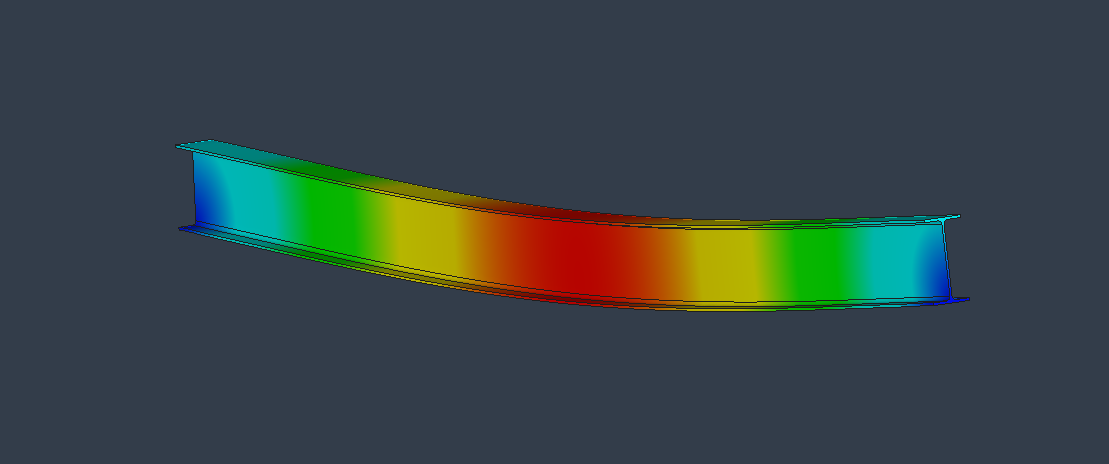
Structural Analysis
Introduction
Finding the right beam for your project can seem like a daunting task. I’m not going to lie, it involves a bit of math and understanding of structural terms, but it is fairly straightforward. Normally, I would start a topic with the steps leading up to the final conclusion, but I am currently working on a design where I need a beam, so I will show my steps to solving this problem.
Definitions
- Yield Strength = The point at which a structure will no longer return to it’s normal, unloaded, condition. The structure will be permanently deformed.
- Ultimate Strength = Maximum tensile strength of an object before total failure (ie. breaking).
- Moment = A bending force applied to an object.
- Shear Stress = The force that acts parallel to the material’s surface.
- Moment of Inertia (Area) = An object’s tendency to resist bending or twisting movement. Specific to static structures (not moving).
- Neutral Axis = An imaginary line in a structural member where the stresses during bending are exactly zero.
- Section Modulus = Used to calculate a beam’s strength when it comes to bending. A factor of it’s geometric shape.
- Safety Factor (SF) = A buffer added into the design to account for unexpected loads.
Design Criteria
The project I am working on is a gantry crane for my shop. I have a lot of heavy items to lift on a regular basis and I’m not getting any younger. The goal of the crane is to be able to lift 6600 lbs. That will satisfy everything that I have planned in the near future.
Safety
Anytime you are designing something that has the potential to fail catastrophically, and that failure could result in serious injury or fatality, you need to have a margin of safety. More commonly known as a Safety Factor (SF), this is just a level above what your design criteria are. For example, my SF is 2.00. This means that my design will be able to hold at least twice the designed weight before structural damage will occur.
As far as the beam itself, I will use a wide flange beam instead of a traditional i-beam. A wide flange beam has flat flanges, whereas the i-beam’s flanges slope down towards the edge. I will also try and find the lightest weight beam that will do the job safely.
Steps To Solving The Problem
- Draw a Free Body Diagram (FBD) to show all known forces and reactions
- Solve for all forces
- Draw a shear diagram
- Draw a moment diagram
- Calculate Section Modulus required.
- Find a suitable beam with section modulus higher than required
- Check shear stress on the selected beam
- Calculate maximum bending stress
- Calculate maximum deflection and check against guidelines.
Step 1: Free Body Diagram
A free body diagram is used to show all forces acting on the component in question. This is used across many engineering and physics disciplines and gives a visual representation of the system.

In this FBD, the red arrow shows the force applied to the beam. The black triangles represent the supports at each end of the beam. The blue arrows show the reaction forces of the supports.
Step 2: Solve For All Forces
Use Moment Equations To Solve For One Reaction Force
A moment equation shows the forces at play, times the distance from the origin. The sum of the moments in a static system like this should equal zero. Think of a moment as the force used to spin the object around the origin.
The moment at an origin is always zero because the distance is zero. This is handy, when we can pick our origin point. In this case, I chose point A as the origin so the equation will be used to solve for the reaction force By.
Another thing to note is the sign convention. Usually motion in the counter-clockwise direction is considered positive. Moments in the clockwise direction are negative. This is not a hard-fast condition, but a general convention. As long as you are consistent, you can choose any direction as positive or negative. For this problem we will stick with standard convention.

Solving For The Reaction Force At Point B
The applied force is in the middle of the beam and its direction would make the beam spin clockwise around point A, so it is a negative number. Notice that the distance for By is 10.92 ft because it is the total distance from point A, not from the applied force. Now we solve for By.

Now that we have the reaction force at B, we can solve for the reaction force at A. In a static system, the sum of the forces in each direction should equal zero. Sign convention says that force pointing down are negative, while forces pointing up are positive.

You’ll notice that Ay and By are the same value, and that value is half of the point load. A shortcut for beam analysis is if the load is directly in the middle of the beam and the beam is supported on both ends, the reaction forces at each support are equal and half the value of the load.
There are two more forces shown in the diagram. The force in the x direction. However, there are no external forces in the x direction as the point load is directed straight down. If the point load came in at an angle, then there would be a force in the x direction. For this example:

Step 3: Shear Diagram
In a shear diagram, a point force shifts the line up or down depending on the sign of the force. The Ay force is a positive 3300 lbs so the line shifts up 3300 at zero feet. At 5.46 ft, the applied force is negative 6600 lbs, so the line shifts down. Then at By, the force is positive and shifts the line up 3300 lbs. Notice that the graph starts at zero and ends at zero.

Step 4: Moment Diagram
A moment diagram show the relationship of the moments along the span. The number we really want in this case is the maximum moment. When there is a positive area in the shear diagram, it equals a positive moment in the moment diagram. The value of that is the area under the box in the shear diagram.
The first part of the shear diagram is above the horizontal axis, which means it is positive. To find the value, multiply the shear (3300) by the distance (5.46 ft). That results in 18,018 lb-ft. The second box is below the axis, so it will be a negative number, but it is equal in area to the first box. This results in -18,018 lb-ft.
A positive value results in a positive slope of the moment diagram. A negative value means a negative slope. Since this example starts as a positive value, the entire moment diagram sits above the axis.

This happened to be a fairly simple problem, but keep in mind that more complex problems will mean more complex analysis. The shear-moment diagrams are vital to understanding the forces and finding the correct values.
Step 5: Calculate The Section Modulus Required.
To calculate the section modulus required, we will use the maximum moment from our moment diagram, and the maximum allowable stress of the beam. If you don’t have a table of values for the material you are using, a simple internet search can easily find reputable sources for that info. We need the yield strength of the material and Modulus of Elasticity (E) in the correct units. In our case we are using English units.
The type of steel used for most structural steel beams is A992/A572-50 Steel. A992 and A572 are two different grades, but they have similar properties. For A572-50, the yield strength is 50 ksi (ksi = 1000 psi). The Modulus of Elasticity (E) = 29,000 ksi.
For Section Modulus Required, we only need the maximum moment Mmax and the yield strength. But since our Safety Factor (SF) is 2.00, we need to divide the yield strength by 2, to give us 25 ksi.


Notice that our units needed to be in inches, but the moment is in feet. That is why it is multiplied by 12. Also, pressure measurements need to all be in ksi or all in psi. I chose psi for this example. The result is a Section Modulus of 8.65 in3.
Step 6: Find a Beam
For this you’ll need a chart of available beams. These are usually found in the back of engineering text books and online resources. I found the following chart on Continental Steel and Tube Company’s website under American Wide Flange Beams.

When selecting a beam based on section modulus, you need to find the Section Modulus columns and the Wx (in3) column. Then look for any number greater than your section modulus required. In this case a W8x13 beam will meet that requirement, as will all of the beams above it.
The beam designation does mean something about the beam. The “W” means it is a wide flange beam. You may also see “WF.” The “8” means that it is an 8 inch tall beam (roughly). The “x 13” means that the beam weighs 13 pounds per linear foot.
Step 7: Checking Shear Stress On The Selected Beam
Now that we potentially have a beam, we still have some more checks to run to make sure that it is suitable in all areas. The next thing we need to check is to see if this beam can handle the shear stresses. To do that, we’ll use a shear stress formula.
There is a more complete shear stress formula, but it requires some additional calculations that are outside the scope of this post. Instead we will use a more simplified version that is compatible with wide flange beams.


This shear equation uses the maximum shear and then divide that by the area of the web of the beam. That information can be found on the chart. The total of that equation needs to be less than the shear stress allowed. According to the American Institute of Steel Construction (AISC), the allowable stress is determined by the following equation for beams if using the Allowable Strength Design (ASD) method.

In the case of an beam made from A572-50, Fy = 50,000 psi, and the safety factor that I have chosen for this design is 2.00. So the shear stress allowed is as follows:

Now we will use the shear stress formula to see if the shear stress in the beam exceeds the value of allowable shear stress.

This beam passes the shear stress analysis.
Step 8: Calculate Maximum Bending Stress
Maximum bending stress occurs at the point furthest away from the Neutral Axis. For a symmetrical component such as our wide flange beam, the equation for finding the maximum bending stress is fairly straight forward.

Mmax is the maximum moment, found in the moment diagram we did earlier. (c) is the distance from the neutral axis, which in the case of our beam is half of the beam’s depth (height). (I) is the area moment of inertia and can be calculated by hand, but we are going to use the provided value from the table for simplicity.

Now let’s solve!

The bending stress of 21,813 psi is below our allowable stress of 25,000 psi. So the beam passes this mark as well.
Step 9: Calculate The Maximum Deflection And Check Against Guildelines
This calculation is important, especially in crane operations. The gantry crane I am building is going to be manual in nature, meaning that I will have to physically push the load to make it move along the beam if necessary. I would like to make sure that I’m not pushing 6600 lbs uphill!
Simplified Equation
For a simple beam with a point load in the middle and both ends supported, the equation for deflection can be simplified to the following:

The (P) represents the point force applied. The (L) is the length in inches. The (E) is the modulus of elasticity of the steel, and the (I) is the area moment of inertia. So now let’s fill in the numbers and solve.

That means the the beam will deflect just of one quarter inch with a full load applied. Now we need to check and see if that is acceptable for a crane. There are several different deflection requirements for a beam. I decided to go with the safest option and base my standard for deflection on an overhead bridge crane. This is similar to my design in that the main beam is supported on both ends. It also has very stringent requirements for deflection, but that only adds to my safety.
Checking Deflection
For a bridge crane, the maximum deflection is determined by dividing the length of the beam (L) by 600. In my case, the length of my beam is 131 inches, so the maximum deflection allowed would be 0.218 inches.
The beam failed the maximum deflection requirements. In truth, this deflection is still acceptable for this type of crane and the work it will do. I would feel confident in using a W8x13 beam for this load.
Selecting a New Beam
However, I know a good way to reduce bending stress is to make the beam taller. If I move up to a W10x12 beam, I not only reduce the bending stresses and deflection, but also get a lighter beam as well. Sure, I only save 11 pounds, but it makes a difference when you have to adjust the height of the crane.
Normally, just moving up in size is a safe bet, however there are some “larger” beams that may have a smaller section modulus. To be on the safe side, I redid all calculations and put them in the chart below to compare the two beams. Try and use the numbers from the chart to do your own calculations and check your answers with mine.
| Parameter | W8x13 | W10x12 |
| Section Modulus | 9.9 in3 | 10.9 in3 |
| Shear Stress | 1.8 ksi | 1.8 ksi |
| Bending Stress | 21.8 ksi | 19.8 ksi |
| Max Deflection | 0.269 in | 0.198 in |
Conclusion
Once you have all the values, the calculations for this process are not too difficult. Just remember to not skip any steps. Also, as you can see from above, we worked the values of one beam only to find at the end that the beam was not as suitable as we wanted. That is part of the design process. Don’t be discouraged if the beam you wanted is not the right one.
Thank You
Thank you for reading my post. If you find that you gained some knowledge and would like to read more, please consider giving us a like and subscribing. It’s free and it helps us get sponsors for future content. Also if you feel we are worthy of a small donation, you can leave a tip at the button below. Every little bit helps as the projects can be quite costly.
Leave a Reply