

Introduction
Today, we are covering the difference between series and parallel circuits, and some of the related math and what it means. This is a basic understanding of this topic to help my readers understand the concepts employed in other posts.
If you have not read DC Circuits – Basics, I encourage you to do so because it will help you understand this topic.
Loads vs Sources
A load is a component in a circuit that uses power. It can be anything that needs to be powered, such as a sensor or LED. For simplicity, this post will represent all loads as resistors.
A source is a component in a circuit that provides power. These are generally batteries in DC circuits, but can also be power supplies that take AC power and convert it to DC power. For simplicity, this post will represent all power sources as batteries.
Series Circuits.
A series circuit is a circuit where the current only has one path. A basic series circuit would be similar to one in Figure DC-2-1.

Voltage Drop
In this circuit the current will remain the same, but there will be a voltage drop across the resistors. The voltage drop will be equivalent to the product of I x R, as per Ohm’s Law. If you have not read the Basic DC Circuits post, please do so to get caught up on Ohm’s Law and equivalent resistance.
Assuming a 2 mA current, what are the voltage drops for each of the three resistors? What is the total drop in the voltage across the resistors?
VR1 = (30,000 Ω) (0.002 A) = 60 V
VR2 = (10,000 Ω) (0.002 A) = 20 V
VR3 = (15,000 Ω) (0.002 A) = 30 V
Vtot = VR1 + VR2 + VR3
Vtot = 60 V + 20 V + 30 V = 110 V
Notice how the total voltage drop across the resistors is equal to the voltage supplied to the circuit. This is because voltage is a measure of electric potential, or a difference in voltage. If it is 110V at the positive side, then it should be zero volts at the negative side.

Batteries in Series
In Figure DC-2-2, we are looking at several batteries in a simple series circuit. Can you determine the voltage and current of the circuit?
When power sources are arranged in a series, the voltages are added. This is the opposite of the resistors in series where the voltage experiences a drop across each resistor. This should pass the common sense test. If you have more batteries, you should have more power!
To find the total voltage supplied in the circuit, simply add up the voltages of the batteries.
Vtot = B1 + B2 + B3 + B4 + B5 + B6
Vtot = 3.33 V + 3.33 V + 3.33 V + 3.33 V + 3.33 V +3.33 V = 19.98V
To find the current, plug the total voltage (Vtot) and the total resistance (just R1 in this case), into Ohm’s law and solve.
I = (19.98 V) / (100 Ω) = 0.1998 A or ~ 200 mA
Parallel Circuits
Parallel circuits are a little more complex than series circuits. These circuits have multiple branches through which the current will flow. Figure DC-2-3 shows a parallel circuit with three branches, each with their own load (resistor).
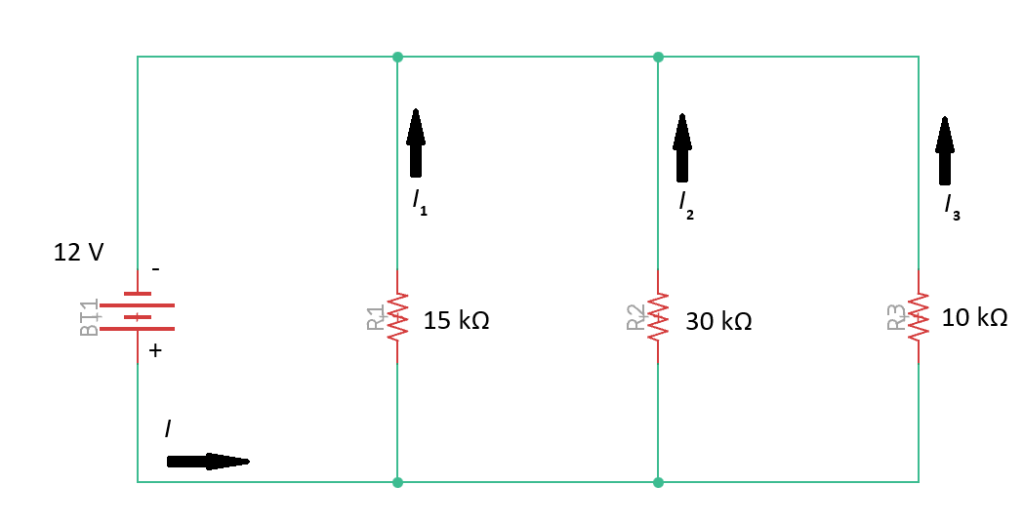
In a parallel circuit, with three branches like the one in Figure DC-2-3, there will be four different values of current (I) that need to be found. The first will be the current of the whole circuit, followed by the current of each branch.
Total Current
To find the current of the circuit, we first need to find the equivalent resistance, like we did in Basic DC Circuits.
- Req-1 = 15-1 + 30-1 + 10-1 = 5 kΩ
- I = (12 V)/(5 kΩ) = 2.4 A
Now that we know the equivalent resistance and the total current, we can determine the current flowing through each branch of the circuit. In a parallel circuit the voltage remains the same. Which means that the voltage drop across each resistor will be the same as the source voltage (12 V).
Branch Current
There are multiple ways to calculate the current flow of each branch. The first way would be to use Ohm’s law and divide the voltage by the resistance of each branch and that will result in the current for that branch. But what if you don’t know the voltage? What if you only know the total current and the value of the resistors? Could you still solve for each current? Yes.
If you have the total current and the resistors, you can find each current by multiplying the total current by the ratio of equivalent resistance over resistance of that branch.
- I1 = I x (Req)/ (R1)
- I2 = I x (Req)/ (R2)
- I3 = I x (Req)/ (R3)
- I1 = 2.4 A x (5 kΩ)/(15 kΩ) = 0.8 kΩ
- I2 = 2.4 A x (5 kΩ)/(30 kΩ) = 0.4 kΩ
- I3 = 2.4 A x (5 kΩ)/(10 kΩ) = 1.2 kΩ
Inverse Relationship
One thing to point out about current flowing through the branches of a parallel circuit is that they are inversely proportionate to the resistance of the branch. Which means that the higher the resistance, the lower the current. Even though R3 is the furthest from the source, it has the highest current flow because it offers the least amount of resistance to that flow. Keep in mind that we are simplifying this circuit by not including the resistance of the wire. In small circuits, it is a non-factor, but if you have to run wire a long distance to reach a component, then it becomes a factor.
Next we will look at having batteries arranged in a parallel circuit as they are in Figure DC-2-4.

Batteries in Parallel
For this circuit, we need to find the current output of each battery and the total current of the circuit. To do that, we would use Ohm’s Law to find the current for each branch, treating it as a separate circuit. For this particular example, all the batteries have the same voltage and they are all connected to the same load (R1), so the branch currents will be identical.
- I1 = (30 V)/ (500 Ω) = 0.6 A or 600 mA
- I2 = (30 V)/ (500 Ω) = 0.6 A or 600 mA
- I3 = (30 V)/ (500 Ω) = 0.6 A or 600 mA
To find the total current of a parallel circuit, you simply need to add the currents.
- Itot = I1 + I2 + I3
- Itot = 0.6 A + 0.6 A + 0.6 A = 1.8 A
Conclusion
Remember that in a series circuit, the voltage changes and the current stays the same. In a parallel circuit, the current changes while the voltage stays the same. Loads in a circuit cause voltage or current (depending on the type of circuit) to decrease. Power sources in a circuit will cause the voltage or current to increase.
Thank You
Thank you for taking the time to read this post. I hope that you learned something or at least got a refresher. Feel free to leave questions or comments below. If you like this content and want to see more, please consider subscribing. It really helps me provide more content for you. Or, if you feel we are worthy, consider leaving a tip.
Leave a Reply